Person-ality

I hate personality tests.

They seem far too close to horoscopes to me, except of course that horoscopes are based on the alignment of the stars while personality tests claim to be based on psychology and research into human behaviour; for decades though I have rejected both of them as being more on the side of worthlessness than worth.

It really is just a personal quirk, as millions of other people, including those who work in HR departments, find these tests both informative and fascinating. And perhaps it is just in my nature to object to these tests at all, because according to the one I completed most recently, being put in a box of any sort drives me bonkers.

Yep, I took a personality test recently, and while the results seemed quite accurate, I was perhaps most astonished in that I have taken this test a few years ago, and it seems, somehow, my personality has changed in the intervening time.

This time my tests revealed me as an adventurer, someone who is fiercely independent and yet an introvert. It showed me to be unpredictable and someone who rejects tradition, convention and normalcy in favour of the untried, the untested and the unusual.

This is a far cry from what my test showed five years ago. And perhaps that is what bothers me most about these tests, as our answers very much depend on our true understanding of ourselves.

Five years ago I doubt anyone would have called me independent, let alone fiercely so; I was quite predictable and had been for years. I lived a very traditional and normal life, happy to be considered quite usual as opposed to someone who seeks things that are beyond the norm; and as such I expect I answered my personality test questions in that manner.

Five years ago, I may have still been an adventurer, but I suspect it was cloaked under who I “thought” I was or who I was expected to be; the wife, the mother, the quiet one who stayed at home.

And then, one day, almost as if a light bulb that had been dimmed for a very long time suddenly brightened, I began to remember who I was a long time ago, when I was far younger.

Unpredictable. Adventurous. Spontaneous. And frankly, always wise enough to know the consequences, but on occasion risky enough to play with them just to see where things might end.

I think that is the real trouble with personality tests; they require a firm enough understanding of oneself to answer not only honestly but with self-truth rooted in knowing who you really are, not who you may appear to others to be, or who you pretend to be.

Even when I did the recent personality test I objected to the idea of my unpredictability, arguing I was far too staid and set in my ways to be unpredictable; and then I reflected on all the crazy-ass, spontaneous, absurd, slightly bizarre, carrying-the-secret-to-my-grave things I have ACTUALLY done in my life and realized the truth of this trait, even if I was tempted to deny it.

And so, perhaps now, after fifty years on the planet and a difficult, occasionally painful but equally joyous journey of self-discovery and learning, I have learned who I really am, fiercely independent, unpredictable, adventurous and yet deeply sensitive.

Perhaps it is in learning who we are not that we learn who we are; this seems to have been the path I had to follow.

And while I now, grudgingly, accept that personality tests may well have some degree of accuracy, I have an even firmer belief that they are only as good as our self-knowledge, coloured by how we see ourselves and whether or not that point of view is accurate.

But unlike horoscopes, which will for me forever remain in the land of worthlessness, I can now read my personality test results and find some degree of worth, as glimmers of who I am shine through.

Do I think I – or anyone – can ever really be captured entirely in a personality test?

No. But do I think there is a chance that on occasion they can capture a glimpse of who we are, and perhaps even help us to see how we have changed?

Yes. And for me, that is a most unpredictable answer, too.

Who Are You? Take the Test!

who-are-you-question-ha-011

Thanks For Visiting. The End.

It’s deja vu, of course.

Another celebrity, another fly-over, another agenda, another drive-by assassination attempt on the industry that fuels my community.

And thousands of words written and spoken and tweeted and Facebook posted and blogged, filled with outrage and anger, and in the end, what happens?

Nothing.

Nothing changes, as it’s a lot of sound and fury signifying nothing, just as it always is when celebrities decide to visit my community and express their “deep concern” over our industry.

It’s a vicious cycle, as they drop in, they stir up the hornet nest, the media reports, the locals go into defensive hyper-drive and then they fly away, never to be seen again in our community, and life?

Well, life goes on, theirs and ours.

Why do we allow them to do this to us time and time again? Why do we even dignify their visits with our outrage and our anger and our time and our emotions?

My chosen response is now this:

Dear X,

Thanks for visiting.

The end.

It’s all they deserve, no matter the song titles or movie credits attached to their name. They don’t deserve our ink, our words or our emotions, because frankly, we have other needs for those right now, like helping our community to rebuild and recover.

And in the future, they will come and they will go, their little journeys into the heart of our community driven by their own agendas and egos and money and whatever it is that motivates them to come here; and at the end of every single visit exactly one thing will have changed:

Nothing.

And if each of these visits results in exactly nothing, what should we be giving them in return?

Well, nothing. It seems like a fair exchange, really. Let them go through the effort of coming here, expressing their “concerns” and repay their efforts with absolute, complete and resolute indifference.

Because I suspect nothing is more infuriating than when their status is met with a total lack of response, and what they think is met with utter indifference because we know, with certainty, that it just does not and will not matter, not tomorrow, not today and not ever.

So yeah, thanks for visiting.

The end.


Platitudes, Panic and Pediatricians

The announcement of the impending departure of a local pediatrician this week would have been troubling enough in a community with a strong young family demographic but when he began to give media interviews indicating his reason for departure as concern over the safety of children due to the current on-call system for pediatricians at our local hospital, it became more alarming than troubling.

 
Physicians rarely give such interviews or make statements such as this publicly; these are serious allegations, and physicians who make them without grounds place themselves in serious risk of professional and even personal sanctions from their professional organization, their colleagues and the government. It is undoubtedly a bold move for any physician to do so, and one has to realize they are either deeply concerned in doing it, or deeply foolish.

 
When the physician in question is one who has garnered tremendous respect, with reportedly 5,000 patients in his care, it would be reasonable to assume he is more likely deeply concerned. And if a physician who is part of the medical system is deeply concerned, then as community members we should be, too.

 
I have been very fortunate in that I and my family have always received excellent general and emergency medical care in our community. Every visit to the Northern Lights Regional Health Centre Emergency Room has resulted in good care, and I have no personal complaints in this regard. However, as someone who has been impacted by the lack of specialty medical care in my community (in my particular case, a local or even visiting ophthalmologist), I am well aware that living in a smaller and remote northern community can be exceedingly difficult when you have a medical concern that requires specialty care. The loss of a pediatrician, regardless of his role as an on-call pediatrician for emergency services, is a concern, as the loss of every medical specialist has the potential to impact quality of life for the residents of this community. His patients, many of whom undoubtedly have specific medical concerns, have every right and reason to be alarmed by his departure, and his concerns over pediatric patients in the ER should not be discounted in any way, and yet Alberta Health Services, in responding to his media interviews, seems to take these concerns rather more lightly than one would hope.


This response, posted in an online AHS blog, seems to fall slightly more on the “throwing shade” side of defense than an actual articulate and reasoned presentation of the reassuring facts. Comments made that they were not aware of his departure and the 90-day notice a physician must give in order to move or close their practice seem more intended to distract from the real issue at hand: whether or not pediatric patients are at risk in our local hospital due to the current on-call system that sees practicing pediatricians pulled from their practices, offices and patients when an emergency requiring a pediatric specialist arises.

 
While AHS contends this system has been in place for decades, that alone is hardly reassurance nor a reason to think all is well, as simply because something has worked for a long time does not mean it works well now. In fact, this reasoning may be one of the greatest threats in every human endeavor and not just medicine, as it leads to complacency and an unwillingness to make changes.

 
What was lacking in the AHS response was three things:
1) Data showing that pediatric patients do not wait for excessive time periods to see a pediatric specialist in the ER and that pediatric patients in our community are “well served” as a whole
2) Evidence showing a lack of negative outcomes from the current on-call system (surely they must collect data of this nature, and if not then I have some questions as to how they can contend it is working)
3) Acknowledgement that this situation is deeply alarming for parents and residents of this community, particularly at a time when many individuals are still recovering from a traumatic year and assessing their ongoing quality of life in our community.

 
Platitudes developed as a PR response simple won’t reassure anyone in this situation. The fear, anxiety and almost palpable panic this has created in our community is clear when talking to parents and visiting social media pages they frequent; the departure of one pediatrician (and the rumoured departure of a second) is worrisome enough, but this is not the first physician who has expressed concerns about health care in our region (although most have done far less publicly) or who has left the community. In 16 years, I have been through 5 family physicians, not because I have chosen to change them but as they have left the community citing overly heavy workloads and their own quality of life as factors in their decision. I came here from a very small community in northwestern Ontario with sincere hopes my chronic eye disease would receive better treatment, and have been sadly disappointed to see those hopes dashed as my move from a community of 3,000 people to one of over 80,000 people resulted in no difference in care as I still travel to see a medical specialist and still have no local access to an ophthalmologist, emergency, resident or visiting.

 
And perhaps that is what bothers me most about the AHS response; in their assertion that pediatric patients are “well served”, I wonder if they think other medical concerns in this community are equally well served, like my own, or like mental health concerns for youth, or any of the other myriad issues requiring specialty medical care which are, quite frankly, NOT well served in this community. Does the phrase “well served” become the “home free” of this government agency funded through our tax dollars, and they believe they can walk away without addressing the concerns and anxiety that exists? And by not countering this assertion that we are “well served”, are we allowing them to believe this to be true?

 
Not so fast, AHS. Platitudes will not reassure in this case. Provide some data, discuss some facts and counter the claims this respected pediatrician has made in a manner that befits the alarm he has raised. If the facts support your assertion, provide them, and be prepared for a dialogue with residents of this community as we want to share with you our concerns regarding our own medical experiences, and those of our families. Understand that to some degree this is still a community in crisis, and it is not “situation normal” in our region as we continue to recover from the events of 2016. Tell us about your efforts to recruit new physicians, share with us the data you have developed indicating the system is working and if there are challenges, be honest and transparent about them, as we are already aware they exist. Show us you have a plan to address them, and assure us you will work with our physicians and us to ensure the kind of health care system that helps us to build a robust quality of life in our region.

 
For residents of the region with concerns over health care, pediatric or otherwise, I recommend emailing the Alberta Minister of Health Sarah Hoffman. Share your stories, express your concerns and ensure your voice is heard as the only way to effect change is to be part of making it happen.

 
This story is not over – and it is not even truly the beginning, as I have been here for 16 years and during that entire time health care and access to it has been an issue, particularly any form of specialty medical care. This is an ongoing issue that has flared and subsided over a very long time, and is likely to do so for a long time to come; but we have an opportunity at this point to ask for some answers as in this case some very serious, and very troubling, allegations have been made.

 
It is now up to Alberta Health Services to respond to them – and with something more than a blog post containing platitudes and hollow reassurances.

2016: Those Moments

Ah, New Year’s Eve, that date filled with both remnants of the past year and glimmers of hope for the one yet to come; an arbitrary dividing line we devised ourselves, and yet cling to as if it is written in the stars.

It has been interesting to watch as the end of 2016 approached, as there has been an outpouring of emotion against one set of twelve months that began on January 1 and ends tonight. There have been various reasons for this angst, those anxious to usher 2016 out the door and welcome 2017, and equally as interesting has been the reaction of those who have tried to convince those who declare 2016 an “annus horriblis” that it actually wasn’t a bad year at all.

The thing we seem to forget is that no one lived 2016 like we did. We each have our own experience of this period of time, those moments each as unique as we are, and no experience is exactly similar. The truism of this was brought home to me when 88,000 people evacuated the same city due to the same natural disaster and not one had the same experience.

Just as in that experience, our experience of the past year is unique to us, and no one can tell us whether it was a “good” or “bad” year – it was, after all, 366 days (being a leap year) of our experiences, not theirs.

We have a tendency to tell people how they “should” feel. And the mantra is often: Don’t be sad, don’t be angry, don’t be, heaven forbid, negative. Be happy, be positive – always!

I know the hazard of this approach very well, as after my mother’s unexpected death I denied myself the opportunity to grieve, only to discover grief would then manifest itself as a physical illness that led to months of medical visits, procedures and anxiety, until I finally learned all I needed to do to heal was to allow myself to feel what I needed to feel.

I am so very happy for those who had wonderful years in 2016; for myself, when a friend challenged me to rate it – was it 60/40 good vs bad, 70/30, 50/50? All I could respond is that it was a blur, an entire year in which so much happened both good and bad and happy and sad and entirely unexpected that it makes my chest tighten just thinking about it.

Nobody was with me when I stood in a field and watched my city burning, and nobody was in my car with me when I lived as a nomad for a month, just a travelling band of three confused but committed felines who, through the experience, have bonded to me like glue and can now be found within inches of me at all times.

Nobody but my daughter knows the words I said to her on the phone as I stood in that field, those moments when I was calculating my own odds of survival, and, for the very first time in five decades of life, realized they may be lower than I would like.

Nobody knows how I felt when I was finally reunited with her a couple of days later, my physical survival now ensured but my emotional compass spinning wildly as I began to comprehend what had happened to me and the community I have come to love.

Nobody was in my head for all the other moments, the highs and the lows, the laughs and the tears. Even if they were present, right there beside me, their experience differed from my own.

2016 was my year. And it was your year too.

However you feel about it – happy, sad or indifferent, you are entitled to feel it, regardless of what factors led you to develop those sentiments towards it.

I learned a lesson long ago when my mother died. I will never deny how I feel about anything and try to push those feelings down in order to feel the way others feel or think I should feel; they are not me, and I am not them. I will not tell them how they should feel, because their experience is theirs alone, and I am in no position to judge because I have not lived their lives.

And how do I feel about 2016 in the end? It was not the worst year of my life; it was not the best. It was a year filled with those moments, so many emotions that it would be difficult to capture in something as simple as calling it “good” or “bad”.

It was, in my lifetime, utterly unique, and for that reason alone I find myself strangely grateful to have lived it, because life is about experience, and 2016 was, barring all else, one helluva ride.

As 2017 looms large, I look ahead with optimism, because that is what I do and who I am, the eternal optimist; and I reflect on the past twelve months – 527, 040 minutes – with respect, with reverence, with joy, with sorrow, with happiness, with sadness and with immense gratitude that I was here to live them.

In 2016, one of my favourite Canadian bands played their final concerts. The lead singer, someone I have adored since adolescence, chose to cease performing due to the early onset dementia he suffers. Watching that concert vicariously through friends who were there was another one of those moments in 2016 when the emotions could just not be captured in one word. The band also happens to be responsible for my favourite New Year’s song, a bit dark and irreverent, and yet brimming with enthusiasm and somehow joyful, too.

Your new year will not be defined by this New Year’s Eve, or January 1. There is another entire year ahead, and it too will be filled with those moments – own every one of them, whether they are happy or sad or both of those and everything in between.

Because those moments, my friends? Those moments are life.

Happy New Year – and welcome, 2017. I stand ready for your moments.

Target Fixation: License to Drive

I got my driver’s license at the age of 33.

That’s one of those bits of information about myself that I tend to hold onto for those “ice breaker” moments at meetings when you are asked to share your name, role and “something nobody would know about you”. It’s innocuous, it’s mildly interesting, and it’s a bit unusual, so it works well in those settings and has stood me in good stead more than once.

One of the things I don’t always share in those moments is that I also took Driver’s Education – for the second time in my life – at the age of 33. Having done it before at the age of 15, but never following through with that whole pesky “getting a license” business, I thought it was wise to do a refresher course in driving with the driving instructor in the very small town I lived in at that time.

My driving instructor was undoubtedly more accustomed to younger pupils. He had abundant patience though, and lessons were going fairly well until one day, for about the fifth time, I found myself veering towards a large wooden bear-proof garbage bin while he yelled “brake, brake” before I could smash it into matchsticks.

There we were, stopped just shy of a garbage bin, when he mopped his brow and glared at me with frustration, the first time I had seen that expression on his face.

“Do you know what your problem is?”, he finally asked. “You don’t look where you want to go.”

I spluttered indignantly for a moment, astonished at this revelation. Of course I was looking where I wanted to go. The fact that I was steering towards the garbage bin (again) was just a freak coincidence, not evidence that I was in some way distracted or worse, looking at that garbage bin and allowing it to become my focal point.

He listened to my attempts at defense, and then said: “The truth, Theresa, is that you will steer towards what you are looking at. If it’s straight ahead, you will go straight. If it’s to the side, you will veer that way. And if it is towards a garbage bin, then you will head right for it.”

Look where you want to go.

It’s called “target fixation”, an actual phenomenon in which we will steer towards what we look at, and it took me until I was 33 and learning to drive to truly understand it.

A few weeks later, both to his intense relief and mine, I passed my driving test, without once hitting a garbage bin and having learned a powerful lesson about driving.

The reality, of course, is that my driving instuctor had given me good advice on both steering my car, and steering my life.

Perhaps this year, during times of challenge and uncertainty, this thoughtful advice has given me more direction than ever before. And I think it is sound advice not only for us as individuals, but for organizations, governments and communities.

Where do you want to go? Do you want to live in the past, enmeshed by the events of the last few months, or do you want to move into the future? Do you want to spend precious time breaking down the could-haves, should-haves, would-haves and rolling them around in your head, or do you want to explore what the future could hold?

It is your choice, and yours alone. And where you look will undoubtedly direct where you will go.

If you look into the past, there is a terrible chance you will end up mired there, unable to move ahead. If you allow yourself to be distracted by the endless side shows that exist in our world, the incessant “hey-lookit-me’s” then you will find yourself headed towards them and steering off your path.

But if you truly want to steer into the future – to move on and to move ahead – then you must focus on it, and look to where you want to go.

It’s a pretty simple concept, but it’s one we quickly forget when it comes to our lives, even if we practice it daily when we drive. We find ourselves looking in directions we don’t really want to go, and almost against our will we find ourselves steering towards them, not even understanding why we are heading that way.

And it is because we have chosen to look in their direction, into the past behind us or the dead-ends or the paths meandering far away from where we actually want to be. It is normal and it is natural and it happens to all of us from time to time, because we forget that in the end, 100 percent of the time, we will steer towards the direction we look.

Life goals, employment goals, community goals; all of these can be attained by simply holding fast to our course and looking towards them. As soon as we look towards the garbage bins of hopelessness, negativity, anger, frustration and despair, we will head right for them.

If we are lucky, we hit the brake before we hit them. If we are not, we collide with them, and the trick becomes steering our way out of them.

I wonder if my driving instructor ever realized that those words, meant to help a 33-year old woman finally get a driver’s license, held far more significance than simple driving advice.

It was sound advice for driving a car – and a life. And it’s sound advice as we move from a year of challenges into another year that will undoubtedly hold new challenges, too. If we continue to look where we want to go, we will steer towards it and one day find ourselves at the destination we have chosen.

Or we can end up in the garbage bins, surrounded by a place we didn’t want to go and unsure how we ended up there in the first place.

The choice is ours. You hold the driver’s license.

Now look where you want to go. 

And hit the gas.

Dear 2016

Dear 2016,

There are people in this world who think the universe conspires to create events to teach us lessons. According to this train of thought, things happen because we are meant to learn from them, and to somehow in the end become better and wiser people.

So my question today, 2016, is what the hell have you been trying to teach us?

Were you trying to teach us that our time is finite and that death comes even for the greats, like Bowie and Prince and Cohen and all the others you took from us this year?

Got it.

Were you trying to each us through the tragic loss of a far-too-young firefighter and local hero that life is short and we never know when it may end, and to make the most of every minute?

Got it.

Were you trying to teach us that life can change on a dime, and one beautiful sunny day can turn into one that ends in smoke and flames and heartbreak?

We got it, 2016.

We fucking got it, okay?

But when you struck down a small local child with cancer, what was the lesson there, exactly?

And how about when you stole the lives of two young adults as they fled a wildfire?

2016, you kicked our ass. You knocked us to the ground, let us get up, and then knocked us down again, over and over and over.

I don’t think you were teaching us a thing.

I think the only lesson one could find here is that life is random and painful and cruel.

And yet it is still somehow incredible and wonderful and a tremendous gift.

With every single ass-kicking you handed out, there have been moments that reminded me that despite the fragility, despite the pain, despite the sorrow and despite the agony, there is beauty and kindness.

And hope.

It is amazing that despite all of the “lessons” listed above, what has struck me most in this past year is hope.

Hope that things will get better, hope for the future and hope for our community.

How has that happened?

Because none of this, 2016, was about lessons. It was about life, this tenuous journey we all find ourselves on, winding down paths and none of us knowing where they will lead.

It is about the best laid plans going astray, about how things you think you know turn out to be wrong and about how life will always, in the end, surprise you.

Sometimes, the surprises are terrible ones, the kind of surprise where you want to close the box, tape it back up and return it to the sender as 1) unclaimed, 2) unwanted and 3) unbelievable. But on occasion, even during the midst of the terrible surprises, are such kind and gentle moments that you are reminded of all that makes this world a good place.

Love.

Courage.

Friendship.

Family.

Resiliency.

Strength.

And hope.

I keep coming back to hope, 2016, as we come to the close of this year. And I know that January 1 is an arbitrary line and there is a chance 2017 will be every bit as difficult as 2016, except for one thing.

2016, you taught me to hold on to hope, because sometimes, hope is all there is.

Hope isn’t always found in things turning out the way you wanted or expected, though. Hope is discovering that no matter what happens, there are people who will be there for you. Hope is discovering that those around you won’t give up and realizing their tenacity fuels yours.

2016, if you taught me ANYTHING it’s that the universe does not conspire to teach us lessons. Life is just something that happens, and we learn along the way.

And if we stop long enough to take a breath, we learn to hope.

I was ready to kick you to the curb, 2016, to say “screw you” as you ended. But now, instead, I find myself reflecting on the past year and focusing not on the moments of flames and smoke and sadness and sorrow but instead on the moments when my heart lifted and I felt hope.

The moment I listed to a David Bowie song and felt joy that he had been on this earth at all to share his talent with us.

The moment I thought about how an entire community became an army, united because of one young man and his battle with cancer.

The moment I saw a small child with cancer smile as she played with stickers donated by strangers from across the country.

The moment I reconsidered dog-earing the page of a book I was reading, because of the memory of a young adult who loved books and who left us far too soon.

The moment I drove under an overpass on which stood the firefighters who fought the flames.

The moment I came back to my community for the first time in a month, and wept with both tears of sadness and relief, finally able to return to the place that has been my home for the past sixteen years.

The moment when I walked into my house after a month away and felt simple overwhelming gratitude.

I have been lucky, 2016, so much more fortunate than so many others; but it is in their courage and determination that I truly began to understand the nature of hope.

2016, you didn’t teach me a damn thing. Every lesson I learned this year was taught not by a tumultuous, topsy-turvy, stomach churning year, but by the people around me. And I am grateful.

This year, just one day before returning to the community I have chosen as home after a month filled with uncertainty, I turned 50. And instead of the things one might think one would feel at that landmark – disbelief at reaching half a century, the sense of your own mortality creeping up on you, wondering what the remaining years would bring – I felt pure and simple joy.

And hope. Hope found in the fact that I was here at all after 50 years, hope that the future would bring good things, and most of all hope that I could be part of making the world a better place, in whatever way I could manage.

So, 2016, you might have tried to break us, but you didn’t. Perhaps you tried to crush us under the weight of it all, but you failed. You see, no matter how dark the night, no matter how thick the smoke and no matter how bright the flames, there is hope.

Dear 2016, thank you for reminding me about the nature of hope. If there was one thing maybe I needed to learn this year, perhaps that was it; and so in the end maybe you did teach me one important lesson after all.

You taught me that hope changes everything.

TEW


I Believe

I still believe.

It’s over 40 years later, and I still believe in the magic of Christmas.

I was not raised believing in Santa Claus. From some recent comments I read online, apparently this should translate into me feeling I was deprived as a child, robbed of the magical spirit of Christmas and decrying my parents for their treachery in not allowing me this belief. And yet Christmas is my favourite holiday, and every year I feel the same sense of awe and wonder I did as a child.

And it has nothing to do with Santa.

My parents, being German-Canadian, celebrated Christmas on December 24. Christmas Eve was a night that began with a huge traditional family meal, followed by carols, the reading of the story of Jesus’ birth, the opening of gifts and then a trek to midnight mass, followed by yet another small meal (did I mention the German part?).

December 25 was a day spent with family and friends, eating, visiting, playing cards and games, reading books and enjoying the simple pleasures of the day. There were no reindeer hoofprints, no fat men in red suits, no chimneys, and on my part no sense of disappointment because for me Santa was just a lovely story.

And while my family was Catholic we were not what I would consider incredibly devout, so that wasn’t the reason for the absence of Santa. It had more to do with how my parents were raised, and their parents before them.

Christmas gifts came from the people around you, who may have scrimped and saved to deliver them. They likely agonized over the perfect gifts, and they were the ones who wrapped them and placed them under the tree. If anything, knowing this made them all the more special, because the gifts I received were directly from those I loved.

I guess there are those who think the magic of Christmas is only found for children within the magic of Santa, the excitement and the anticipation; and yet for me the magic was in my family.

  • The Christmas dinner my mother lovingly prepared, far more food than any family could ever consume in one sitting and leading to the necessity of two fridges in their home to hold leftovers alone.
  • The way my father would always find the homeliest, saddest and most misshapen tree on the Christmas tree lot and bring it home, introducing me to the concept of the Charlie Brown tree long before television did
  • How my dad would pull out his accordion, a massive black and silver beast that so very few people can master, and begin to play carols.
  • The sounds of my parents’ voices as they sung Silent Night, not in English but in their native German, the language that had both spoken until they went to school as children.
  • The bowls of mandarin oranges that would be passed around several times, leading to orange over-consumption and no interest in that particular fruit for the rest of the year.
  • The way my parents welcomed in “strays” – people who had nowhere to go for Christmas, far from friends and family of their own. This is actually how I learned about multicultural diversity, as our guests could be from anywhere in the world, but our home was their home at Christmas.
  • Doing the dishes – by hand! – after that massive meal before we could get to the presents, leading to everyone helping as it made the work go so much faster and the presents arrive sooner.
  • Midnight mass, the one time of year when going to church actually seemed beautiful to me and when it reflected the peace, joy and love of the season.

And yes, the presents.

As I reflected recently on those childhood Christmases I recalled the year I found a large box under the tree. I must have been around 7, and in that box was a toy that would entertain not only me but entire future generations of grandchildren, nieces and nephews.

My Fisher Price Play Family Castle was not from Santa. It was from my dad, with his rough and worn working hands, and my mom, who often was found with a bit of flour on her face from baking bread for her family. This gift and those Christmases burn brightly in my memory not because of Santa, and not because of a lack of magic, but because my parents were the true embodiment of the season: kindness, joy, peace, love and family.

The singing of Silent Night in German still makes me weep, especially since it has been almost a decade since either of my parents were alive to sing it.

Mandarin oranges still make me smile, and I can still eat a dozen in one sitting.

I have an inordinate fondness for real Christmas trees that are far from perfect specimens, and I still own my dad’s accordion, even though I cannot play it and just take it out once in a while to touch the smooth keys.

Sometimes, even though I am far from religious, I still go to midnight mass and let the feelings of peace wash over me.

And this year I went online and found a vintage 1974 Fisher Price Play Family Castle, which is now on its way to me as a reminder of all those Christmases so long ago.

It may seem an unusual nativity scene, and yet I know it is destined to become part of my Christmas decorating tradition, taking me back to my childhood and a time that lives on forever in my memory, but mostly in my heart.

Because that is where the magic truly is; deep in my heart and intertwined with memories of my mother, my father and Christmases long past.

15253502_10154504251310743_2937197455094527972_n

Own Every Second

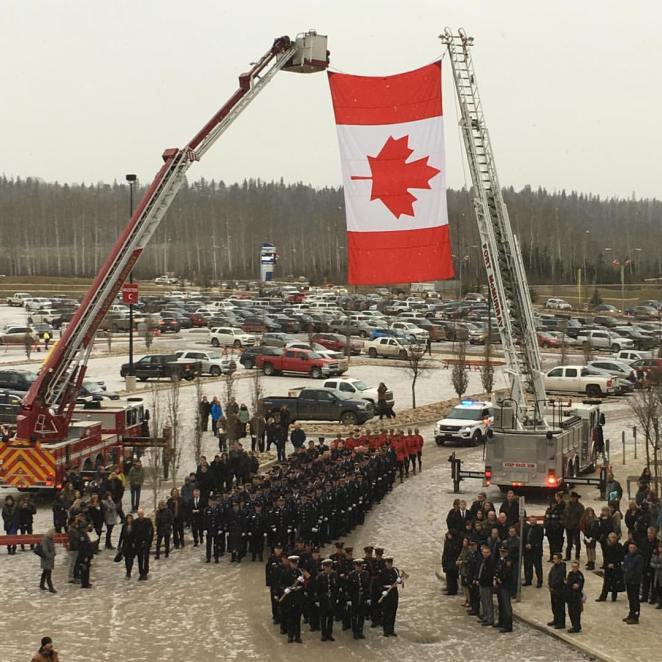
It is an oddly familiar scene, reminiscent of a day not that long ago. As soon as I see the flag billowing in the wind, the fire trucks using their ladders to hold it aloft, I feel tears pricking the corners of my eyes, and the day has not yet even truly begun.

15056259_10154454577635743_6094645317146211637_n

I stand there for a moment, transfixed by the flag as soft fluffy snowflakes fall from a grey sky; it is undoubtedly the kind of sombre day when a community will say good bye to a hero.

There were hundreds of touching, compelling, soul-searing and heartbreaking moments during the memorial service for Bo Cooper. I am at an age now where, as my older sister quips, you go to more funerals than weddings, and for the most part the funerals are for those who have lived long lives; but a handful have been services for those who left us far too soon, and while memorials are always painful it is the ones for those who are too young to be gone that can shake you to the core.

What can one write about Bo Cooper that has not already been written or said? What can the lesson or meaning of this bright young life tragically cut short possibly be? We struggle to find meaning in such situations, where meaning seems elusive and the only thing one can find is a sense of finality and cruelty.

A reporter asked me recently why Bo Cooper captured the hearts of the residents of this community. I could not answer for everyone, but for myself I responded simply that Bo could have been my son, my nephew, my brother, my family; and in a sense he became all of our son as we watched his battle with a deadly foe. It took such courage to allow the rest of us into this fight, as these are deeply personal times, as I know well having been through them with my own family, but Bo and his family shared their fight with us, and we felt we became part of it, too. We fought for Bo and with Bo; we became his army.

15069023_10154454906465743_7268916478156775378_o

I will not write of the memorial service, as there are aspects too tender and fragile to put into words such as these. The only thing of which I will write are the words from Bo’s father, who thanked the community for raising the funds that bought Bo time – another year in his estimation, an additional 365 days to be with his wife and his parents and his family and his colleagues. The words from a bereaved father were both incredibly heartbreaking and compelling, and if there is any meaning to be found in this sad ending it may be this: the value of time.

The time we have on this earth is finite. Some of us are granted decades while others are granted just a fraction of that; and while we all want the decades what matters more than the amount of time we are granted is how we spend it.

I suspect if we saw time as the precious commodity it is we would treat it with more reverence; perhaps we would ensure we lived every day to the fullest and allow ourselves to savour every experience. The sad reality is that it is often only as our clocks tick away the final moments that we realize the value of time, and wish we had used our own allotment differently.

It is a cold truth that on occasion we need sad prompts to remind us of things we should inherently know. As I sit and watch snowflakes fall from the sky after the memorial service, I contemplate the minutes I have already been allotted in this life and how I intend to spend the remaining ones, no matter their number. I think about the legacy I hope to one day leave, and I think about how I intend to achieve it.

There are not enough words to express the feelings surrounding the loss of a young man who both lived and fought so very tenaciously. He lived a short life, far, far too short by any measure, but he lived it well and he lived it being loved by his wife, his parents, his friends, his colleagues and yes, his community. He has left a legacy through the kind acts he inspired, and through his father’s eulogy he has reminded us of the thing in our lives that may be the most truly precious: time.

However many moments you are granted – whether they are only brief or lengthy, make them good ones. And treasure even the bad moments, because you have been granted the opportunity to experience them, a chance others have been denied.

Own every second that this world can give.

When your time runs out, make sure you can say this:

“I swear I lived.”

Policy vs Person in Politics: The Peril

Politics has never been easy.

Being in the public eye, particularly when one is representing a political party, ideology and/or agenda, opens one to criticism and scrutiny, and this has always been true. But in recent years the descent into outright hostility seems almost unprecedented, much of it likely having to do with the easy anonymity of social media and lack of consequences for words said in on online forums. Politics, which has never been easy and on occasion has been quite nasty, has somehow managed to get even far more unpleasant.

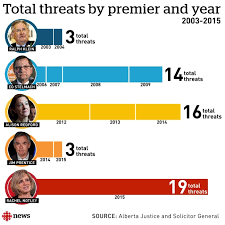
A recent report showing Albertan Premier Rachel Notley as the most-threatened Premier in Alberta history seems to lend credence to this evolution:

images

It’s troubling on many levels, particularly when one sees instances of abusive behaviour dismissed as simply being acceptable or understandable because they involve politicians; and these abusive acts don’t end at attacks on ideology but extend into attacks on character, person and on occasion even spill over into threats against the families of the politicians.

Society has long been founded on the premise that there exists some sense of decorum in our interaction with each other as human beings, no matter where we lie on the political spectrum. It is based on some fundamental respect for each other as people, whether or not we share the same political beliefs, and it is predicated on the notion that we do not need to dive into personal insults or, even worse, threats, to engage in reasonable discourse on the issues.

But social media has changed that in many ways, and we are seeing it again and again and again. Whether it is municipal, provincial, or national, we seem unable to separate difference of political belief from our emotional state, leading to the use of aggressive language, occasionally including veiled and overt threats to the safety of those involved.

And when those who object to this abuse publicly state they will not tolerate, accept or understand it, they are deemed wimps for not just taking it – sometimes even by elected officials.

And the real trouble is this: the current pattern of behaviour is a strong deterrent to anyone thinking of entering the political realm. People like my daughter, for instance.

My daughter was involved in her first political campaign at the age of 12. She spoke to voters, she dropped literature on hundreds of doorsteps, she knocked on doors, she wrote her first press release, she attended debates and she was there on election night watching the results. I don’t know how many kids have had CBC news alerts installed on their cell phone since they were old enough to own a cell phone, but she did. She is the kind of kid who can speak to a provincial politician and walk away saying “nice guy, but I don’t think he really understands NAFTA”.

Any political party would be fortunate to find her in their ranks, as she is smart, loyal, dedicated, committed and frankly a strong strategist. Once upon a time she talked about getting involved in politics, but as she has grown older her interest has waned, and as she begins to apply at universities I see her heading down the path towards a future that does not include involvement in politics, at least as a candidate representing the rest of us.

And why?

Because she doesn’t see why anyone would subject themselves to the kind of vitriol and nastiness we are seeing politicians of all stripes endure, but often particularly women.

I blame all of us, the ones who are old enough to know better. Our behaviour is actively discouraging bright, engaged and passionate young people from political life, and it will be to our detriment. Politicians should not be rock stars, and should not be safe from all criticism; but nor should they be subjected to the kind of abusive and aggressive behaviour we are seeing far too often in this world. There are ways to disagree on policy without delving into the personal, and ways to discuss ideology without resorting to insult; and every single one of us needs to find a way to embrace them as our political futures are fading fast as young adults like my daughter turn away from public life.

If we want to understand why youth turn away from politics; from engaging in our system including voting, then we need look no further than ourselves every time we contribute to an atmosphere that would discourage any sane individual from taking part. Politics should always be about asking the hard questions on policy, but the moment it degenerates into personal commentary it loses all credibility. Respectful debate and discourse should be the standard to which we all aspire and which we encourage; to do anything less panders to a culture of anger, aggression and divisiveness.

When young adults like my daughter – the very people we should want to encourage to enter the political realm – choose to opt out, we need to understand we are imperiling our future. My daughter, who plans to pursue an education in science, has long thought those with a science background are under-represented in our political sphere and thought she may be one of those to address this. Given the current state, however, I fear this imbalance will continue as bright young adults eschew politics for careers in which they are not subject to abuse, aggression or threats to their physical safety.

The responsibility lies with all of us. As long as we tolerate, accept or understand this behaviour we allow it to continue, and we allow it to form future discourse in politics. Unless we address it every single time we are tacitly encouraging it, and further discouraging others from entering a realm that impacts our collective future.

The problem is clear; the only question that remains is if we believe in a society that is free of abuse, aggression and threats, including in the world of politics.

I know what I believe; do you?

Homecoming for a Hero

Although the news was sadly expected, my initial reaction was unanticipated.

Instead of the sorrow and grief I thought I would feel, there was another emotion in their place.

Rage.

White hot, blinding and seething rage.

Bo Cooper, the young firefighter who brought out the very best in our community, who fought as valiantly as one can fight, our very Unbreakable Bo, gone after his long war with cancer ended.

And my first response was rage.

Over the last few months I have been able to work through much of the anger I have experienced. Anger over the loss of two young adults during the evacuation; anger over the loss of so many homes; anger over an inanimate act of nature that took on a persona as it stole so much from my community.

But I had never gotten past the anger over one thing.

Earlier this spring when Bo’s cancer had gone into remission, plans began for a hero’s welcome, a homecoming befitting someone who had drawn an entire community together. We had become Bo’s Army, many of us tied to each other  by only two things: that we call this place home, and that we stood with Bo. We had watched every part of his fight, checking the Facebook page of his journey daily to see how he was doing, feeling relief when he was improving and worry when things were not going as well.

But when he left the hospital to return home, it was with a sense of triumph that the plans began. Bo had won the battle, although all knew the war was not over. Bo was coming home, and it was time for a moment in the sun when he could come together with his army, when they could welcome him home with open arms and he could see the strength of the army he had inspired.

The tentative date for this celebration, Bo’s welcome and homecoming?

May 4, 2016.

When I fled this community on May 3, 2016, many things weighed heavy on my mind; Bo’s triumphant homecoming being delayed was one of them. But I took courage in the belief that it would just be postponed for a day or so, certain we would be back home soon and could then celebrate with our hero.

It was not to be.

You see, my anger when I heard the news today was because this is not the way the story should have ended.

Bo should have had his hero’s welcome, and then he should have gone to his home with his wife to live a long and happy life, and none of our town should have been lost in a wildfire and life should have been simple and good.

But you don’t always get to write the ending.

I don’t know why some of us are granted longer on this earth than others. There is no sense of fair play at work here, no equality of being; some of us get lucky, and some of us get robbed.

Bo got robbed, of his life and of the happy ending he should have had. He got robbed of that homecoming and that moment in the sun.

There are people who change the world without even trying or knowing they are doing it. Bo Cooper is one of them, because what Bo inspired in this community was unlike anything I had ever really seem before. We rallied together for one person, one young man facing a tremendous battle; we felt deeply connected because of him alone.

Bo reminded us of what is best about each of us, and about each other. Perhaps, in some strange sense, the fight to save Bo prepared us for what came next, a life-altering event that demanded we be there for each other in ways we never had before. Maybe, just maybe, the lessons we learned as we became Bo’s Army were the ones we needed when we had to become an army of survivors.

Bo didn’t get his homecoming on May 4th. I will always feel anger over that, and of all the fire took, perhaps it is that one thing that will never be forgiven in my mind.

But perhaps there is a way we can still give Bo that homecoming. Perhaps it is as simple as engaging in acts of kindness for each other. It doesn’t need to be a huge gesture; something small is just as significant as something grand. Just acts of kindness, and when you commit these acts do one simple thing: tell yourself that this is because of Bo.

Let Bo’s triumphant homecoming be each and every one of us working to be kind to each other as we continue to fight our own battles in this community. Let the strength and courage we found  being part of his army become the strength and courage we need to keep moving forward.

Let Bo’s homecoming be us memorializing his life in our acts of kindness to each other.

Let us honour Bo Cooper, one young man who fought so long and so hard, by allowing his journey to turn us into better people, and a stronger community.

Let that be Unbreakable Bo’s legacy: a community forever changed by one man, and by the kindness he inspired in all of us.

My deepest sympathies to Bo’s wife, family, friends and colleagues.

14611005_10154269226633043_1231698457398160502_n